


PLM Governance Benchmark - Overview
Background
The idea of running a multi-company PLM benchmark was first raised by Knorr-Bremse in June 2011. In common with many user companies they want to know, in quantifiable terms, how well their organisation is set up for PLM.

|
Knorr-Bremse is a global company of around $5bn sales, 16000 employees, operating in nearly 30 countries. Their aim is to generate quantified information about the whole scope of their PLM implementation, from the highest level down to the details:- |
- "What, exactly, is achievable in PLM today, and in the future?"
- "How well does our operational setup support our business strategy?"
- "How do we compare with other companies in the functionality we provide?"
- "How efficient are we in using budgets and resources compared to other companies?"
 |
After an extensive discussion phase during Q1 involving almost 20 different organisations, Thales hosted a Workshop in Paris with, Knorr-Bremse, DCNS and Honeywell to confirm the scope and structure of the international benchmark of PLM Governance. |
|
 |
||

|
||
Project Timeline
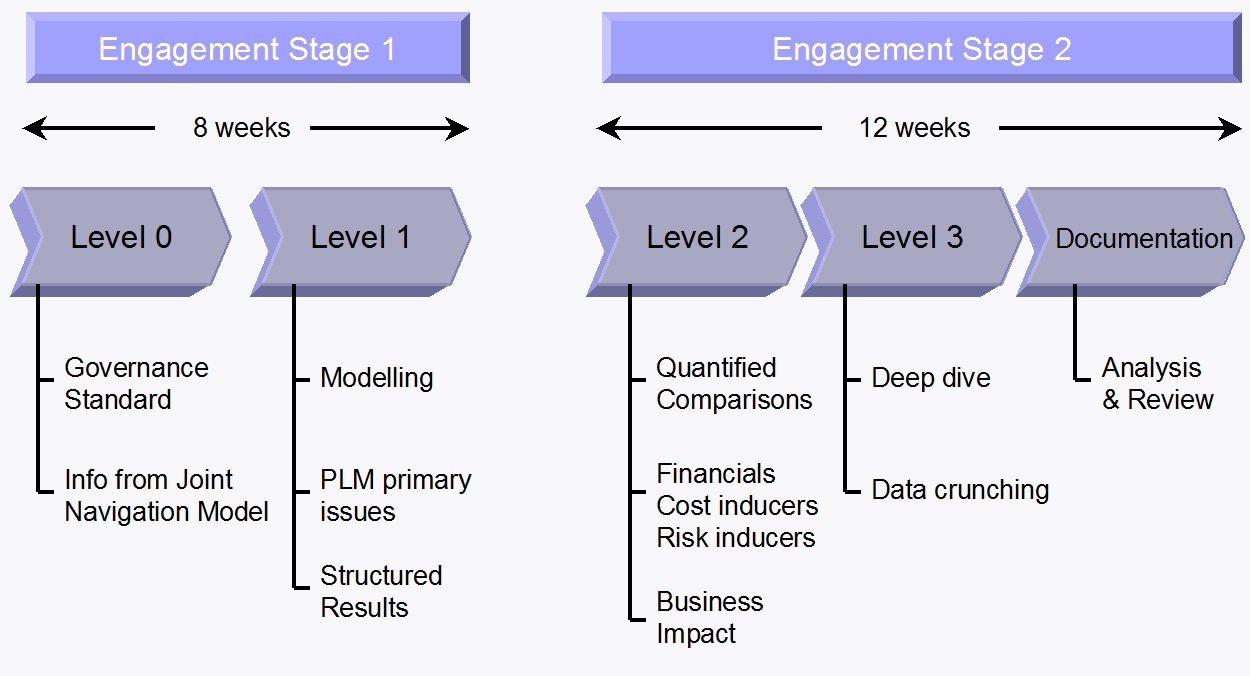
The 'Core Schedule' takes place in two stages:-
- Stage 1: (Level 0 & Level 1 Analysis) - 8 weeks.
- Stage 2: (Level 2 & Level 3 Analysis) - 12 weeks.
|
For each participating company, the PLM Governance Benchmark will deliver a comprehensive appraisal of current PLM capabilities, strengths and weaknesses measured in comparison to other real implementations.
At the governance and management level, it will give quantitative answers to questions such as:-- Are we set up correctly to implement and support PLM?
- Are we covering the full PLM scope?
- Do we have the right levels of responsibility within the organisation?
- Are we agile enough to adapt PLM to the changing shape of the business?
- Are our relationships with our vendors set up correctly?
- Do we over-govern or under-govern our subsidiaries?
- How well do we manage multiple business models?
- How well do we manage PLM in joint ventures?
- How well do we manage PLM in the Customer and Supply Chains?
- PLM Service Levels
- Application of Metrics and ROI
- Staffing and Resource Management
- Requirements / Test/ FMEA Management
- Product and Portfolio Management
- Configuration and BOM Management
- Product Costing
- Process Management
- Change Management
- Document Management
- CAD/CAM/CAE Integration
- PLM-ERP Integration
- CRM and SCM Integration
- Service, MRO and Through-Life Support
- Compliance Management
- Integration with Quality
- Integration with Lean and Six Sigma
- DASAMASA and low-cost markets
- PLM Alignment with New Ventures and Joint Ventures
- M&A Integration
- Regional, Language and Culture Support
- PLM Roadmapping and Future-Proofing
- Adoption of New Technologies
The aim is to launch with around seven or eight companies, from as many parts of the world as possible, so more partners are needed. In order to benefit from the PLM Governance Benchmark, your company needs to take part in it.
The Benchmark structure has been designed so that each company can find its initial positioning in as little as four elapsed weeks. To find out how to do this, see the Full Benchmark Details and then follow the links at the bottom of that page.
Read the Full Benchmark Details >>>
Copyright 2013. PLM Interest Group
