|


PLM Interest Group |
|||||||||||||||||||||

|

|

|
|||||||||||||||||||
|
|
|
|||||||||||||||||||

|

|

|
|||||||||||||||||||
|
PLM AI Working Group
|
PLM 2025-35 AI Working Group
The PLM AI Working Group is a collaborative project that aims to demonstrate the best-practice methodology for applying Artificial Intelligence within the PLM environment. PLM has very specific requirements in terms of how AI should interact and perform, and also offers areas where AI tools could be particularly useful.
The AI Working Group brings together people who want real solutions and leverages the advanced knowledge that has already been gained, crystallising the facts so that everyone can work right first time. Solid ideas and concepts will be in a framework that doesn't move. The depth and complexity can be explored in detail and everyone can start to build. This is a holistic, year-long collaboration that will transform the ease and efficacy of AI implementation within PLM. |
||||||||||||||||||||
|
PLM AI Working Group
|
Benefits
Users may experiment for themselves with AI tools, waste an enormous amount of time, and become disillusioned. They will only move forward and implement real AI when they have a clear understanding of how to do it, and a clear framework that shows how and when the benefits will be achieved. The PLM industry can create this framework by enabling AI adoptors to learn from each others' progress in a structured development environment, using a 'shared sandbox' methodology that builds the optimum working AI system for each participant. The PLM 2025-35 AI Working Group enables everyone from around the industry to collaborate in a neutral, structured environment that leverages the collective knowledge and expertise that has already been gained: crystallising the facts so that users can refer to them and start from the right place; and analysing the detailed technical issues that must be understood before AI works. |
||||||||||||||||||||
|
PLM AI Working Group
|
Advanced Capabilities
There is an ongoing debate about whether PLM should be 're-imagined' for the modern age of smart products. Mainstream applications have evolved from the product landscape of the early 2000s, and may not have evolved far enough; ERP has developed separately, meaning that PLM ERP integration continues to be a major issue; MES, CRM etc. still need bespoke interfaces; and legacy systems are still a complex and unwanted overhead. AI offers the chance to rethink the PLM paradigm, and PLM-ERP offers a very good example. If we started afresh now we would create a single, comprehensive Product Management system, which deals with everything from configuration and manufacture through to sales performance and quality improvement. AI, applied in a very advanced way, could blur the boundaries between PLM and ERP, and in so doing could provide the new functionality that would build them into this new integrated entity. And it could do the same with MES, CRM, ALM - integrating factory operations in a seamless way that has never been possible before. It will require a level of preparation, discussion and implementation that is higher even than the company-wide orchestration of AI agents, and the AI Working Group is uniquely placed to provide this. It may well be the best opportunity the PLM industry has to leap forward into the new age. |
||||||||||||||||||||
|
PLM AI Working Group
|
Methodology
The Project is entirely practical. Over the course of 12 months we will test and build a working PLM AI environment, and define the roadmap of possible implementation routes. The programme is fully integrated into the PLM 2025-35 Project as one of the three parallel streams. As the Project starts, every participant has a different AI setup and outlook. In Mobilisation, the first step is to define a core logic that everyone can work with; and then to agree the method by which testing can be carried out without disruption to operations or prejudice to IP. The third step is to define the Sandbox itself so that it will be representative but also flexible for individual needs. The Generation phase is the engine room of the Project. Participants collectively test their versions of the Sandbox and the PLMIG processes the results. In parallel with this the Group addresses the advanced possibilities of AI for PLM, again coordinated and documented by the PLMIG. In the Confirmation phase everything is rationalised, structured, and laid out as a roadmap for PLM AI best practice. This neutral layout is integrated with the PLM Body of Knowledge, while participants take away their own fully-advanced configurations to continue with into the future. |
||||||||||||||||||||
|
PLM AI Working Group
|
Industry White Paper
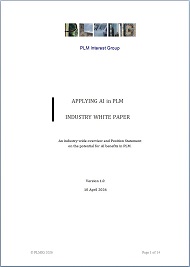
PLM practitioners who are applying AI need clarity about the benefits and pitfalls, and some neutral guidance about the best route to implementation. The Industry White Paper provides the starting point.
There is an explanation of the 'Golden Rule', and a Vision that enables everyone to look to the future. Positives and negatives (because there are negatives) are highlighted, leading to a section on Industry Best Practice and the possibilities of enhancing AI adoption through collaboration. The White Paper is published at Version 1.0 for general discussion, and feedback from practitioners everywhere is invited. A Feedback Form is provided. Download the White Paper [Word] >>> Download the White Paper [PDF] >>> |
||||||||||||||||||||
|
PLM AI Working Group
|
The Proposal
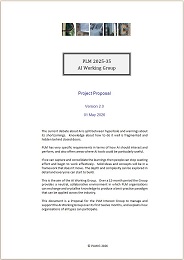
The Proposal shows how the White Paper can be brought to life. It sets out a 12-month framework of active collaboration that will not only establish what AI best practice is in the context of PLM, but will give each project member their own live, running, optimised AI system.
The collective target is to produce the landscape and roadmap that will become part of the industry-wide PLM Body of Knowledge. The target for each participant is to have developed their test 'sandbox' into the fully-functioning, comprehensive AI platform they will use into the future (for users); or to position and enhance their products and expertise within the best-practice paradigm (for vendors and providers). Download the Proposal [Word] >>> Download the Proposal [PDF] >>> |
||||||||||||||||||||
|
PLM AI Working Group
|
Find Out More
The first thing to do is to download the White Paper and see what you think of it. It cuts through the hype and collects the facts into one reference document, simplifying the picture and making it easier to think about what can be done. Then look at the Proposal. For those who are spending serious time and effort on making AI work, the Proposal shows how collaboration and structured testing within the Working Group allows you to get faster and better results. If you would like to know how this could work for you, you can request more information via © Copyright 2026 PLM Interest Group |
||||||||||||||||||||
| <<< Return Home | |||||||||||||||||||||

|

|

|
|||||||||||||||||||
|
|
|||||||||||||||||||||